Foundation, New York & London
Improving Neuro-Inclusivity

Context
We partnered with a Foundation that invests in non-profits to support successful programmes supporting under-privileged youth to scale. There were 93 employees across two offices in New York and London. The Leadership team asked for our support to help them utilise their diversity to strengthen team cohesion and increase innovation.
‘Being part of the Design Group meant our whole programme was built with and for our team, generating a lot of trust and commitment.’
Foundation Director, NY Office
Project overview
We worked with leaders in London and New York to co-design an initiative that would enable the Foundation to identify and understand diversity. The initiative was underpinned by our 3D approach that maps experience through triangulating human-centred experiential data; enabling focused in-depth understanding of teams and environments. The final programme that the team engaged in was built through the combined knowledge gained through individual, team and organisational lived-experiences.
The programme had six stages:
1. Establishing the Design Group
2. Co-creation of survey + comms
3. Survey analysis
4. Workshop design
5. Run workshops
6. Workshop and data analysis
Stage 3 revealed a greater range of diversity than the Foundation was previously aware of. This was primarily in the form of neurodiversity. Only a small proportion of team members responded ‘Yes’ to questions about neurodiversity in previous staff surveys. The percentage of the Leadership team that now identified as neurodiverse had increased from 3% to 21%
By inviting team members to co-design the initiative, the Foundation was able create a psychologically safe environment, where colleagues felt able to be open.
During Stage 4, the Design Group discussed the importance of giving colleagues the opportunity to experience each workshop twice - one as more of an immersive experience, the other to gain insight from live interaction. As a result, we spaced the workshops by a week (rather than running concurrently). Average attendance at all three workshops was 92%. Format and ability to ask live questions during the workshops was one of the most commended aspects of the initiative’s evaluation.
Impact and next steps
The programme enabled holistic, person-centred understanding of neurodiversity across the Foundation, and the ability to utilise strengths that were previously unknown. Three months after, there was an unexpected period of Covid-19 related lockdowns. Having an enhanced understanding and awareness of each other meant work could be quickly redistributed to maximise everyone’s strengths – such as the ability to leverage extreme urgency and ongoing change to achieve focus and clarity – and that the Foundation remained fully operational rather than having to close, as was the case during the previous lockdown.
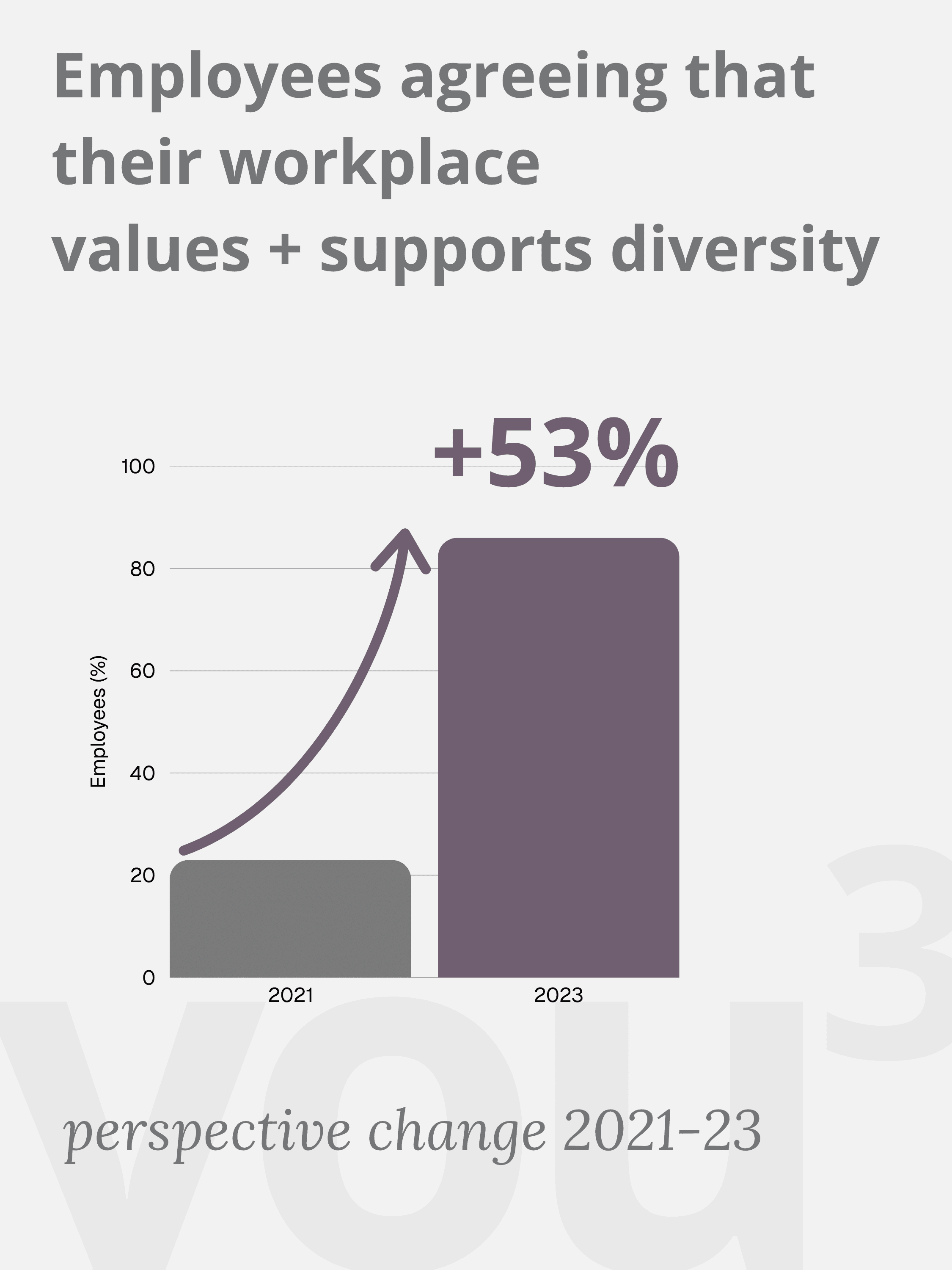
The proportion of employees agreeing that the workplace values and supports neurodiversity increased by +63% at the next staff survey (96% return rate).
Following the initial project, we worked with the Foundation to develop a strategic plan to embed neuro-inclusivity into policies, practices and approaches. We also helped review the Foundation’s rubric used to support investment decisions and created a new communications strategy.